
Amaya Gentry
On Jan. 20, 2025, President Donald Trump signed Executive Order 14151, “Ending Radical and Wasteful Government DEI Programs and Preferencing.” The order directs federal officials to terminate specified DEI and DEIA programs and activities.
Executive Order 13985 was revoked the same day by a separate order, Executive Order 14148, “Initial Rescissions of Harmful Executive Orders and Actions..
About 14 months later, in March 2026, another executive order, “Addressing DEI Discrimination by Federal Contractors” Executive Order 14398 defines “racially discriminatory DEI activities” as disparate treatment based on race or ethnicity and requires covered federal contracts to prohibit those activities.
The rollbacks are associated with the Heritage Foundation’s Project 2025, a long list of policy recommendations that would change the executive branch under the Trump administration.
How the Trump administration characterizes DEI mandates
Executive Order 13985 defines former President Biden’s Equity Action Plans as “forced illegal and immoral discrimination programs” and says these “plans demonstrated immense public waste and shameful discrimination.”
Executive Order 14398 says DEI mandates in the workplace “impose artificial costs in hiring, promotion, and operations by precluding implementation of merit-based principles; creating excessive workforce turnover by elevating immutable characteristics over job performance; and jeopardizing the sort of employee collaboration and problem-solving that is essential to fostering efficient and high-quality work.”
What DEI rollbacks mean in the workplace
The revoking of Executive Order 13985 does not affect all DEI programs in place in the United States. Executive Order 13985 required all agencies to publish equity plans identifying barriers underserved communities face in accessing federal benefits.
Additionally, Executive Order 13985 says, “Director of the Office of Management and Budget (OMB) shall, in partnership with the heads of agencies, study methods for assessing whether agency policies and actions create or exacerbate barriers to full and equal participation by all eligible individuals.”
The White House Executive Order 14398 eliminates “disparate treatment based on race or ethnicity in the recruitment, employment (e.g., hiring, promotions), contracting (e.g., vendor agreements), program participation, or allocation or deployment of an entity’s resources”. It also requires the OMB to issue punishments such as cancellations and suspensions for entities that fail to comply with the terms of this order.
Federal contractors and subcontractors may face contract termination, suspension, cancellation, or debarment for noncompliance.
This does not mean that companies’ obligations to comply with anti-discrimination laws have changed, though. Companies are still required to prevent harassment, accommodate disabilities, and prohibit retaliation.
Who is affected by DEI rollbacks
DEI policies in the workplace first expanded in the 1980s, about 20 years after the enactment of the Civil Rights Act of 1964 according to many sources including the Hudson Institute’s Workforce 2000 report. Around this time, many movements were taking place, such as the Equal Rights Amendment attempt of 1972 and the Stonewall uprising of 1969.
With racial, gender, and LGBTQ+ rights at the forefront of public consciousness, workplaces began to create more inclusive DEI policies.
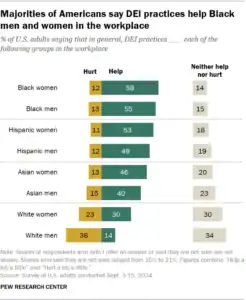
According to CNN, DEI programs may benefit more than just people of color. White women, people in the LGBTQ+ community, veterans and people with disabilities also are protected under workplace DEI programs.
A McKinsey study estimated that white women have benefited the most from DEI programs. The study found in C-suite jobs, women hold 29% of positions: 23% are white women and 7% who are women of color.
Takeaways
Modern workplace diversity, equity, and inclusion (DEI) practices developed from civil-rights, equal-employment, disability rights and affirmative-action efforts and later expanded into corporate diversity and inclusion initiatives.
However, critics argue that the orders could weaken workplace initiatives intended to address barriers faced by historically marginalized groups.
The orders align with several Project 2025 recommendations on DEI, which claim that DEI programs have wasted resources and have discriminated against applicants outside the groups targeted by those initiatives
However, data have shown that DEI programs may have been put in place to benefit many different types of people, including women, veterans and people with disabilities.
Amaya Gentry has a bachelor’s degree in biology and has worked as a quality control chemist.