Staff Writer
Editor’s note: Ron Calhoun, publisher of The Cleveland Observer, serves on the Central East Design Review Committee since. Calhoun attended the Sept. 10 meeting and participated in the discussion and voted to table the University Hospitals proposal.
Design reviewers want University Hospitals to show what would replace the century-old houses before demolition moves forward.
University Hospitals will have to provide a clearer redevelopment plan to win the Central East Design Review Region Committee’s support for its proposal to demolish 12 houses along East 115th Street near its University Circle medical campus.
The committee tabled the request after members questioned demolishing the houses before UH presented a specific plan for what would replace them.
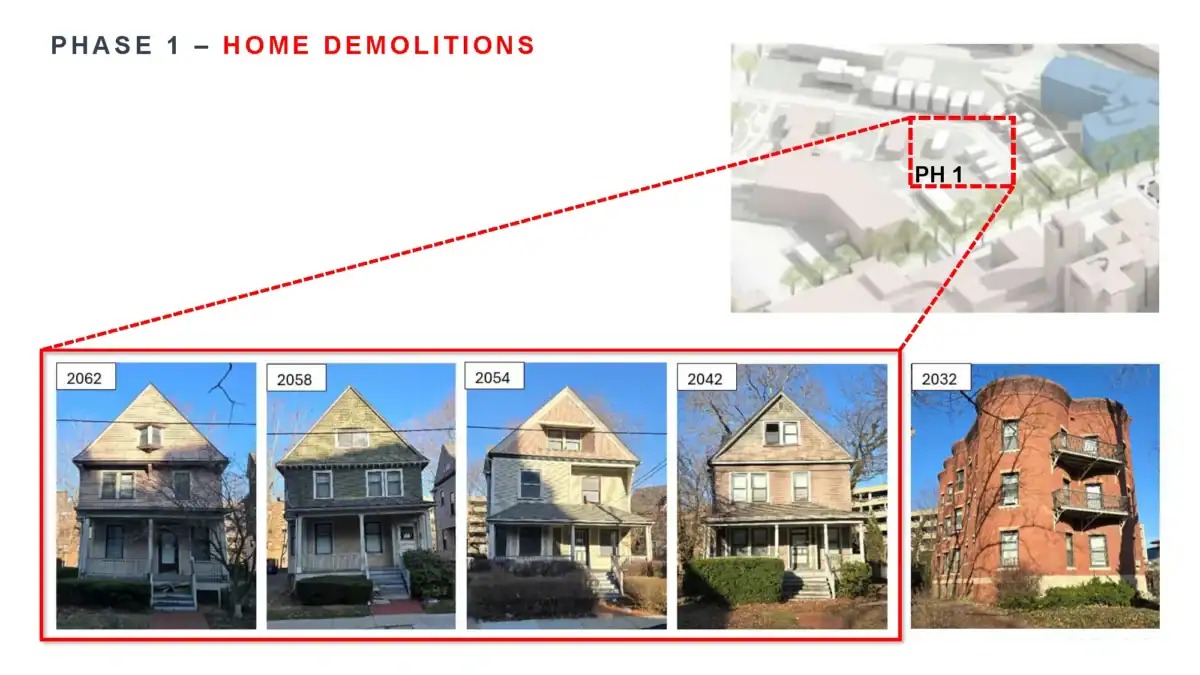
Chris Trotta, the Central East Design Review Region Committee chair, who abstained from voting presented the University Hospitals proposal. He proposed demolishing 12 houses UH owns along East 115th Street. Three other houses would remain and are being considered for sale, while a duplex used by Transplant House of Cleveland would remain.
The houses were built around 1900. Trotta expressed to the committee that, based on their research, the properties are not listed on the National Register of Historic Places, are not in a local landmark district and are not individually designated landmarks.
The presentation outlined a phased plan. The immediate phase called for asbestos sampling and abatement, demolition of the 12 houses and associated driveways and garages, filling basements, removing an existing wood fence, retaining trees and planting turf.
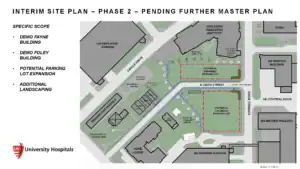
A later interim phase contemplated new sidewalks, lighting and landscaping, along with possible asphalt parking areas.
The presentation also showed a long-term concept for a health care “Center of Excellence” and parking structure. That phase was labeled as more than 10 years away and dependent on completion of a master plan.
Why the developer says it is needed
UH Cleveland Medical Center President Stathis Antoniades told the committee the hospital eventually needs additional space because of capacity constraints at its University Circle campus.
“We know that we will need to expand because of the capacity constraints on our University Circle campus, but we do not have definitive plans,” Antoniades said.
Antoniades said, “UH’s emergency department is overwhelmed and that the hospital operates at 95% to 98% occupancy”.
He said the East 115th Street parcels represent what UH considers its only opportunity for campus expansion in that area.
UH’s presentation described the demolition as a “catalyst” for eventual campus growth while acknowledging that the best long-term use has not yet been determined. It said future use would ultimately be based on patient clinical needs.
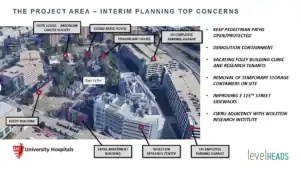
UH officials also cited pedestrian safety, deteriorated sidewalks and opportunities to improve the area. At the same time, they emphasized that long-term expansion needs — not simply the condition of the houses — were driving the demolition request.
What residents and reviewers are saying
Committee members repeatedly questioned why demolition should happen before UH presents a specific project for the site.
One committee member said they were concerned “that a neighborhood be replaced by grass and contractor parking,” adding, “I don’t find that as an acceptable trade-off.”
Another committee member questioned why the homes could not be sold or placed under another arrangement that would allow them to be rehabilitated.
“If this is beyond the means of University Hospital to maintain and operate residential properties … then there you have options other than demolition,” the member said.
The Cleveland Restoration Society submitted a Sept. 3 letter strongly opposing the demolition. The organization described East 115th Street as “a remarkable, intact collection of century-old residences” representing an increasingly rare part of University Circle’s residential history and character.
The society also challenged the idea that the condition of the houses should justify removing them.
“That deterioration should not become a self-fulfilling justification for demolition,” the organization wrote. It also noted that neither UH nor University Circle Inc. had publicly shared a redevelopment plan explaining why demolition of the neighborhood was necessary at this stage.
The organization raised a separate concern about public spending, arguing that in a city needing safe, affordable housing, public funds should prioritize rehabilitation when possible. It urged the Central East Design Review Committee to deny demolition.
In a separate written public comment, Dana Noel asked the committee to pause demolition long enough to determine whether historic-preservation requirements associated with state demolition funding had been satisfied. Noel cited the Ohio Department of Development’s Building Demolition and Site Revitalization Program and said required historic review had not yet been verified.
Noel did not ask the committee to permanently block UH development. Instead, the letter urged officials to verify preservation requirements and consider whether some properties could be rehabilitated for patient housing, support services or another use compatible with UH’s mission.
University Circle Inc. acknowledged both UH’s need for additional land and community objections to demolition.
Matthew Provolt, UCI’s director of planning and design, said the organization wanted “the final outcome to balance these competing priorities.”
What was decided
A committee member moved to table the demolition request until “a bona fide building is presented to us” for the site. The motion was seconded and passed.
The committee chair summarized the decision by saying the proposal would remain tabled until UH presents a more concrete conceptual plan showing what would happen after the houses are demolished.
The committee did not approve the demolition request.
Questions that need to be answered
Several significant questions remain:
- What specifically does UH intend to build on the East 115th Street properties?
- Why should demolition occur now when UH’s own presentation places the proposed Center of Excellence more than 10 years into the future?
- When would permanent redevelopment actually begin?
- Could some of the houses be sold, rehabilitated or reused instead of demolished?
- How much state demolition funding has been awarded or approved for the project?
- What historic-preservation review is required under that funding program?
- Has that review been completed, and where can the public see the documentation?
- Would temporary parking eventually become permanent?
- When will UH present an updated campus master plan to the design review committee and the public?
UH’s presenter said the Cuyahoga Land Bank was expected to complete demolition in the fourth quarter of 2026 and that first-phase interim improvements were expected by the second quarter of 2027. It also said master planning could restart in 2027 or 2028. Those timelines were part of UH’s presentation before the committee tabled the request.
What happens next
UH officials said they could return with a 2019 master plan to illustrate the institution’s previous development thinking, although Antoniades said that plan was not approved by UH’s board or finance committee.
Officials also said developing a new plan would take longer and did not provide a timetable for returning to the committee.
Until UH returns with a more concrete proposal, the demolition request remains tabled.
Why it matters
Demolishing the 12 houses would permanently alter one of the remaining residential streets within University Circle’s heavily institutional landscape.
The central issue is not whether UH may need additional medical space in the future. UH has argued that it does.
The immediate question is whether century-old houses should be demolished now when UH has not yet presented a definitive replacement project and its own long-term concept places a possible Center of Excellence more than a decade away.
For residents, that distinction is important: the physical change could happen long before the permanent development.
For now, the demolition remains a proposal, not an approval.
Transparency note: This report is based on the Central East Design Review Committee presentation, discussion, public comments and vote; University Hospitals’ East 115th Street demolition-strategy presentation; a Sept. 3 letter from Cleveland Restoration Society President Kathleen H. Crowther; and written public comment submitted by Dana Noel. The Cleveland Observer will continue tracking the proposal as UH returns to city review.