
Amaya Gentry
Severe storms, high winds and ice in Northeast Ohio can damage trees and threaten homes, vehicles, utility lines and public spaces.
Property owners deciding whether to remove a tree should weigh immediate safety risks against the environmental and economic benefits of retaining a healthy tree. Tree removal may be necessary when a tree is dead, diseased, structurally unstable or interfering with essential infrastructure.
When tree cutting may be beneficial
Tree removal may be appropriate under certain conditions.
According to The Arbor Day Foundation, removal is generally considered when a tree is dead, diseased, structurally unstable or cannot be made reasonably safe through pruning or other treatment.
Signs of these conditions include deep cracks in the tree’s bark, discolored leaves, soft, crumbly wood and the appearance of fungi. Other evidence includes suddenly leaning trees, a hollow trunk, root defects like fungi or sprouts, and the tree generally not growing well.
However, even healthy trees can pose a risk. High winds and lightning can damage limbs or entire trees. The American Public Power Association reported that trees caused about 16% of public power outages in 2023.
Removal should not be presented as the default preventive measure. Depending on the tree’s condition, professional inspection, pruning or monitoring may address the risk without eliminating a healthy tree.
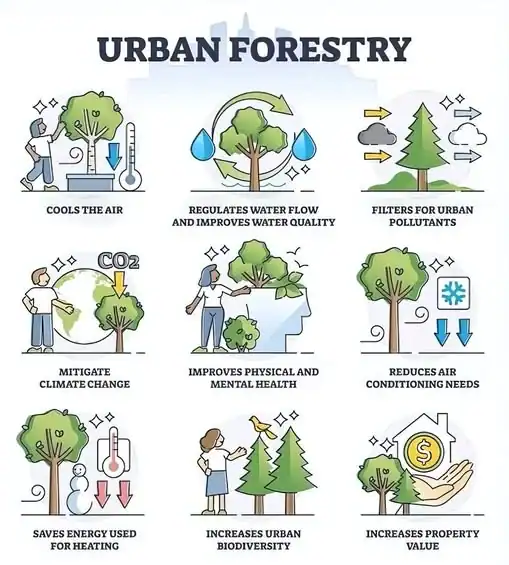
Healthy trees can add value to residential property, while dead, damaged or poorly placed trees may detract from a property’s appearance or safety. A 2021 University of Nebraska-Lincoln study estimated that trees add more than $31.5 billion annually to the value of private residential properties nationwide.
Like other parts of a yard, trees require maintenance. Tree-care costs vary according to a tree’s size, condition, location and accessibility.
According to Affordable Tree Services of Ohio LLC, the care cost depends also on the equipment required.
Tree-removal costs vary widely. Affordable Tree Services of Ohio LLC estimates that removals in the region typically range from $2,000 to $4,000, depending on the tree and site conditions.
Environmental and community costs of tree removal
A 2018 U.S. Forest Service study estimated that urban and community tree cover declined by about 175,000 acres, or approximately 36 million trees, annually about 2009 and 2014.
The study found that urban trees provide important environmental benefits, including helping regulate temperatures and providing wildlife habitat.
One benefit of urban tree cover is temperature moderation during hot weather. Urban trees provide shade and release water vapor, helping reduce the urban heat island effect during hot weather.
A 2026 study published in Nature Communications found that existing urban tree cover offsets about 41% to 49% of the maximum potential air-temperature urban heat island effect. The researchers estimated that tree cover reduces summer air temperatures by a population-weighted average of 0.27 degrees Fahrenheit.
Removing a hazardous tree can reduce the risk of injury or property damage. Removing a healthy tree, however, can eliminate shade, wildlife habitat and other community benefits. The decision should be based on the tree’s condition, location and assessed risk rather than appearance alone.
Removal is not the only response to a potentially hazardous tree. Depending on the condition and location, an arborist may recommend pruning, continued monitoring or another corrective treatment. When removal is necessary, replacing the tree with an appropriate species can help preserve canopy benefits.
Cleveland residents should request an assessment before pruning or removing a public tree or a tree in the public right of way. The city requires permits for work on city-managed trees. Owners of private trees should consult a qualified arborist, while trees interfering with electrical lines should be reported to the electric utility.
Takeaways
Removing dead, hazardous or poorly placed trees can reduce some safety risks and may improve curb appeal, while removing healthy trees can reduce shade and habitat.
Homeowners concerned by the environmental impacts can invest in maintaining their trees and consider options offered by their energy company for tree maintenance.
For public trees in Cleveland, contact 311 or the Division of Urban Forestry at 216-664-3104. A city permit is required before pruning, removing, planting, root-pruning or grinding the stump of a city-managed tree.
Amaya Gentry has a bachelor’s degree in biology and has worked as a quality-control chemist.