
Jennifer Bailey
Instead of relying primarily on jail or hospital emergency departments for people experiencing mental health crises, communities are turning to collabortive programs to provide support and individualized care.
Programs such as the Crisis Intervention Team (CIT) and Support Team Assisted Response (STAR) in Denver Co. exemplify this approach. CIT programs, train officers to recognize signs of a mental health crisis rather than interpret the behavior as criminal intent.
Meanwhile, programs like STAR dispatch mental health practitioners, emergency medical technicians (EMTs) and paramedics to nonviolent calls, prioritizing de-escalation and connections to care.
Research from the Urban Institute shows both models support their communities, but experts warn that systems must overcome unstable funding, workforce shortages, limited community-based psychiatric support and statewide variability.
Past initiatives provide insight into how even effective programs can still fall short and close. Long before STAR, there was CAHOOTS (Crisis Assistance Helping Out On the Streets). Launched in Eugene, Oregon, in 1989, the program was operated through the White Bird Clinic.
The program spent decades de-escalating crises and preventing thousands of arrests as reported by CAHOOTS. In 2024 alone, CAHOOTS responded to 17,000 calls, relying on city contracts, grants and financial support from the White Bird Clinic.
To expand the model, Congress introduced the CAHOOTS Act on March 16, 2021. The bill would have permitted state Medicaid programs to cover certain community-based, mobile crisis interventions outside of a facility setting.
However, the legislation required formal documentation, billing infrastructure and Medicaid-compatible procedures that diverged from the original grassroots CAHOOTS model. Advocates said the requirements created barriers for the original CAHOOTS mission. CAHOOTS services ended in Eugene on April 2025, after White Bird Clinic said it lacked the financial capacity to continue full-service mobile crisis response there. CAHOOTS service continued in Springfield.
The closure serves as a cautionary tale for states like Ohio trying to navigate the same funding challenges. Luke Russell, executive director of National Alliance on Mental Illness Ohio (NAMI Ohio), emphasized the need for a system to track and ensure basic services for the 85,000 to 90,000 adults with severe mental illness in the state. According to Russell, this population accounts for a significant share of Medicaid spending while receiving limited community support.
To address the funding gap, Shannon Scully, director of justice policy and initiatives for NAMI, suggests a “braided” funding approach that taps into federal grants, state Medicaid and local tax levies.
“We’re talking about building out a mental health crisis system that provides people with a mental health response; what we’re really talking about is kind of building out what SAMHSA refers to as the three elements of crisis care,” Scully said.
The Substance Abuse and Mental Health Services Administration (SAMHSA) defines these elements as “Someone to Call” to “Someone to Contact. The criteria are outlined in the January 2025 National Guidelines for a Behavioral Health Coordinated System of Crisis Care.
This formally account for text/chat/video capabilities offered by the 988 Suicide & Crisis Lifeline alongside standard telephone lines, and adopted “A Safe Place for Help” to better encompass crisis stabilization centers, peer-run respites, and alternative receiving facilities.
Because individuals who receive support from CIT or non-police-based programs usually need more than a one-time interaction, connecting them to long-term therapeutic services is critical.
However, Ohio faces a severe shortage of psychiatric inpatient beds. Gov. Mike DeWine and the Ohio Department of Mental Health and Addiction Services, or OhioMHAS, have expanded capacity by opening a Central Ohio Behavioral Healthcare (COBH) facility in May 2024. The newly constructed 208-bed, 270,000-square-foot state psychiatric facility at 2200 West Broad Street.
Russell said the state needs an additional 1,000 beds. He also pointed to the lack of group home availability and the high turnover rate among case managers.
Local initiatives have tried to bridge this gap. The Cuyahoga County Diversion Center, operated by Oriana House, provides diagnostic assessment and detoxification services.
The need is visible locally; the 2025 annual Mental Health Response Advisory Committee (MHRAC) report noted 25 incidents in which CIT-trained officers were dispatched directly to the Diversion Center to support individuals in crisis.
Developing such local initiatives across Ohio is complicated by a decentralized patchwork of 88 counties, 50 mental health boards and layered local governance. Russell explained that this structure makes a unified statewide approach difficult. He advocates for an adult framework similar to OhioRISE, a program currently limited to children, to streamline housing, case management and daily care.
While statewide programs promote cohesion, they can limit local flexibility. “I actually view local home-rule authority as a really great opportunity for customizing what the community needs,” said Emily Ribnik, director of the Criminal Justice Coordinating Center of Excellence. “These issues are getting addressed from the top down and the bottom up, which is often the most effective.”
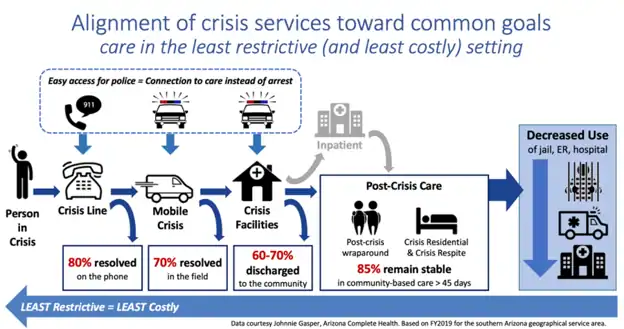
The goal is to connect people with community-based care rather than jail or a hospital emergency department, as shown in the accompanying chart. Tucson, Arizona, has successfully maintained an alliance between mental health leaders and law enforcement by investing in an infrastructure of crisis lines, mobile teams and stabilization centers.
Data from the Tucson model show that up to 80% of crises are resolved over the phone, reducing jail and emergency department crowding. With proper follow-up care, 85% of people remain stable. Tucson’s success lies in using “off-ramps” away from the criminal justice system.
Ultimately, whether communities implement CIT or STAR, the goal is the same: to provide community-based resources that ensure individuals experiencing a mental health crisis are connected with care instead of jail.
Jennifer Bailey is a licensed clinical social worker and registered drama therapist.