

By S. A. Lewis
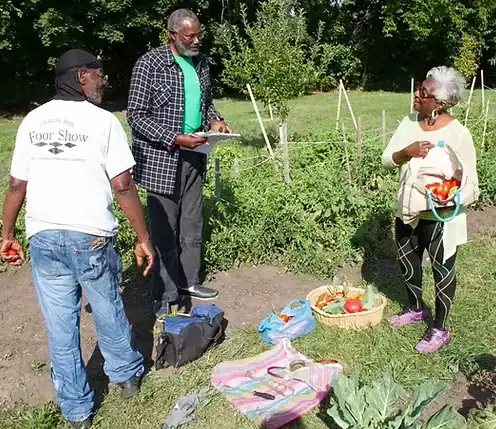
As a lifelong Cleveland resident, it pains me to admit that I was unaware of Vel’s Purple Oasis, a community garden in the University Circle neighborhood located at 10835 Frank Ave.
This nonprofit community garden serves 700 to 800 families annually. Recently, I met with Vel Scott, founder and director.
Lewis: How long has Vel’s Purple Oasis been in operation, and what prompted you to start it?
Scott: We started the garden in 2008. You may remember Vel’s on the Circle, a nightclub owned by my husband (Don Scott) and me.
When we had catering projects, we would drive out to the country to buy fresh fruits and vegetables. Don, being the visionary that he was, suggested we grow our own fruits and vegetables.
He bought the land and convinced me to start the community garden. We started with one lot and expanded as more lots became available, creating the oasis that you see today.
This garden is important to me because health and wellness are now my passion.
After Don was diagnosed with high blood pressure in 2008 and his health began to decline, I realized that I did not know a lot about his condition or proper diet.
Over time, his condition worsened, and he passed away in 2010. I realized then the importance of diet and health in our community. I want to help others and feel it is now my purpose.
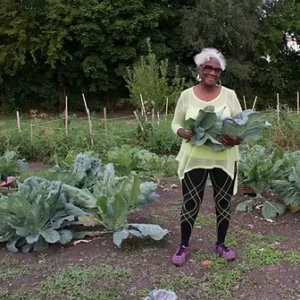
Lewis: This garden currently takes up just under 3 acres. What did you have to do to get started?
Scott: Don and I took the Market Gardening Course from the Ohio State University Extension. It was a 12-week intensive course. Afterward, we secured our first grant from the City of Cleveland. But that was not the hard part.
The land was covered with rocks. Initially, I asked some neighbors if they would help me clear the land. When they arrived, they were overwhelmed by the size of the proposed garden and backed out. Eventually, volunteers helped clear the land, and we planted our first garden.
Lewis: What fruits and vegetables do you usually plant?
Scott: We always plant collard, mustard, and turnip greens. These are staples. We usually have tomatoes, cabbage, beets, onions, and rutabaga. Other crops depend on available seeds and donations. We also have apple, peach, pear, and plum trees. There is an herb garden. I was introduced to herbs as a girl and have always enjoyed the flavor they add to food. In addition, we also plant flowers.
You will find marigolds, roses, and dahlias among others. We briefly had chickens, but they were too much work. We had to send them back to the farm they came from. I could not chase them up and down the street with the rooster following behind.
Lewis: Do you sell or donate the food?
Scott: We give the food away. For example, we will deliver 50 pounds of apples to schools and local community centers. Nearby churches and mosques often receive food or have members who volunteer. When we harvest, anyone can come and get food.
Lewis: Do you have a headquarters or an office? What about staff, or do you function primarily with volunteers?
Scott: In 2009, we opened the Don Scott House around the corner from Vel’s Purple Oasis. That is our headquarters. It hosts our community kitchen for healthy cooking lessons, canning classes, chair yoga, exercise and meal preparation. It is also the place where we prepare the fruits and vegetables for donation.
Right now, I do the work of two and a half people, which is about as much as I can stretch myself. My daughter also works with me. She led the redesign of the Don Scott House. I also have a small staff and some volunteers, but we always need more for planting, harvesting and additional wellness programs.
Many nearby colleges and schools have fraternities, sororities or environmental clubs whose members volunteer. There are so many people in the community with talents and skills that could benefit the community. Our door is open to them. There is always room for more programming.
Lewis: How does a person go from being a business owner (court reporting and nightclubs) to owning and operating a community garden and community kitchen?
Scott: I’ve been blessed with a long life and good health, and I feel our community needs health and wellness resources. Through my southern upbringing around food preparation, Don’s illness, personal research, and the programs we host at the Don Scott House, I know that this education is vital.
My mission is to help while I can. I believe I have more work to do. This is my purpose, and it is fulfilling.
S.A. Lewis is an educator, certified functional nutrition counselor and licensed minister who founded Christian Quest Ministries in Cleveland.