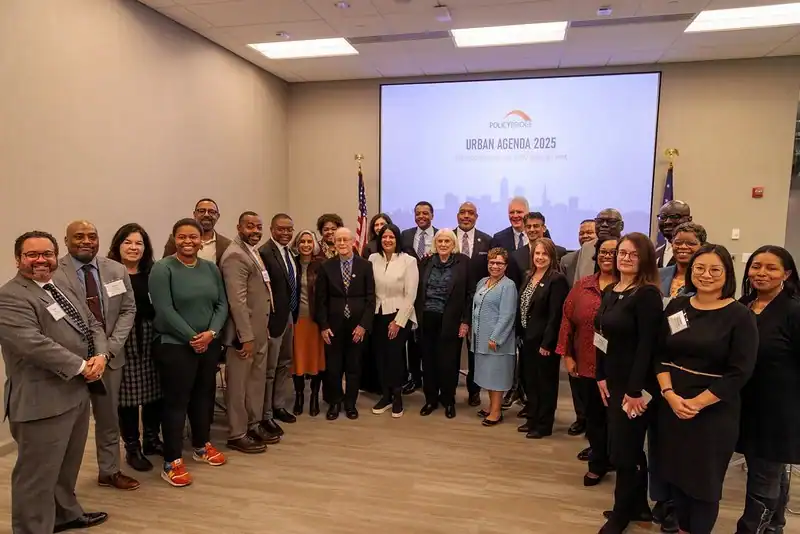
Greater Cleveland Partnership’s launch of the Urban Agenda marks one of the broadest alignments of Cleveland-area institutions around economic mobility in recent years. It also reflects a growing willingness among civic leaders to name racial income and wealth disparities directly rather than framing poverty solely as a general economic issue.
The Urban Agenda Memorandum of Understanding, led by PolicyBridge, has a shared commitment to focus on three key outcomes:
- Raise Black and Hispanic/Latino median incomes
- Increase Black and Hispanic/Latino homeownership
- Close the racial wealth gap.
“The Agreement is an economic imperative and regional competitiveness mandate,” said Randell McShepard, Chairman and Co-Founder of PolicyBridge, at the signing event at the Greater Cleveland Partnership.
At the same time, the announcement outlines only a structure for collaboration rather than a plan for implementation. No specific policy proposals, program changes, or funding commitments are identified, and no timelines or benchmarks are publicly defined.
Experts analysis
Experts who study urban poverty and regional economic development say that distinction is significant.
“Setting shared goals and creating a coordinating body are important first steps,” said David Erickson, a senior fellow focused on community development at the Federal Reserve Bank of New York. “But without clear policy levers, funding streams and accountability, these initiatives often struggle to move from alignment to impact.”
Erickson’s research and leadership on cross-sector collaboration and community strategies are documented through his publications and role at the New York Federal Reserve.
“Coordination is not the same as redistribution,” said Dr. Andre Perry, a senior fellow at the Brookings Institution who studies racial wealth gaps. Perry’s book “Black Power Scorecard” examines the racial gap in economic power and offers approaches to closing it, emphasizing investment in assets like homeownership and business ownership as part of structural solutions.
“If the underlying systems that determine wages, housing access and asset ownership don’t change, disparities tend to persist even when institutions are well aligned,” said Perry.
A familiar approach in Cleveland
The Urban Agenda follows a pattern seen in several previous Cleveland initiatives that emphasized cross-sector collaboration as a path to economic improvement. Over the past two decades, efforts such as the Greater University Circle Initiative aligned major institutions around neighborhood investment and redevelopment. While those efforts produced physical development and institutional cooperation, their impact on poverty reduction and household wealth was limited.
Business-led regional collaborations, including Cleveland Tomorrow and later the Greater Cleveland Partnership, promoted coordinated economic growth strategies that contributed to downtown development but did not significantly narrow racial or neighborhood economic disparities.
Large-scale planning and infrastructure initiatives, such as the Opportunity Corridor, similarly involved extensive stakeholder engagement. Surrounding neighborhoods and existing residents saw only indirect benefits, particularly in terms of income growth and wealth building.
Urban Agenda approach
Organizers of the Urban Agenda say the initiative differs from past efforts because it includes public tracking of outcomes, a designated backbone organization, and sustained engagement across sectors.
Transparency alone, however, does not guarantee results, said Margy Waller, a public policy consultant and former advisor on federal anti-poverty initiatives.
“Dashboards can be powerful if they are tied to consequences,” Waller said. “The question is whether poor results will lead to course corrections, policy changes or new investments, or whether the data simply documents disparities everyone already knows exist.”
The community wants and needs resources
For residents, the central issue is whether institutional alignment will translate into concrete changes, such as new policies, shifts in funding priorities, or changes in how major employers and institutions operate, that measurably improve incomes and reduce poverty.
Past experience suggests coordination alone has not been sufficient. As experts note, the long-term impact of the Urban Agenda will depend less on who signed the agreement and more on what decisions follow it.