By Brooke Adams
Ohio’s debate over property taxes remains one of the state’s most closely watched political issues, with competing proposals advancing as an effort to eliminate property taxes shifts to 2027.
The Committee to Abolish Ohio Property Taxes announced on June 5 that it will no longer seek a spot on the November ballot.
Organizers said they were unable to gather enough signatures before the state’s July 1 deadline and will continue collecting signatures in hopes of placing the measure before voters in 2027.
The proposed constitutional amendment would prohibit taxes on real property, including homes, land and permanently attached structures, according to Ballotpedia.
Supporters say the measure would provide relief to homeowners whose tax bills have risen as property values increased across Ohio.
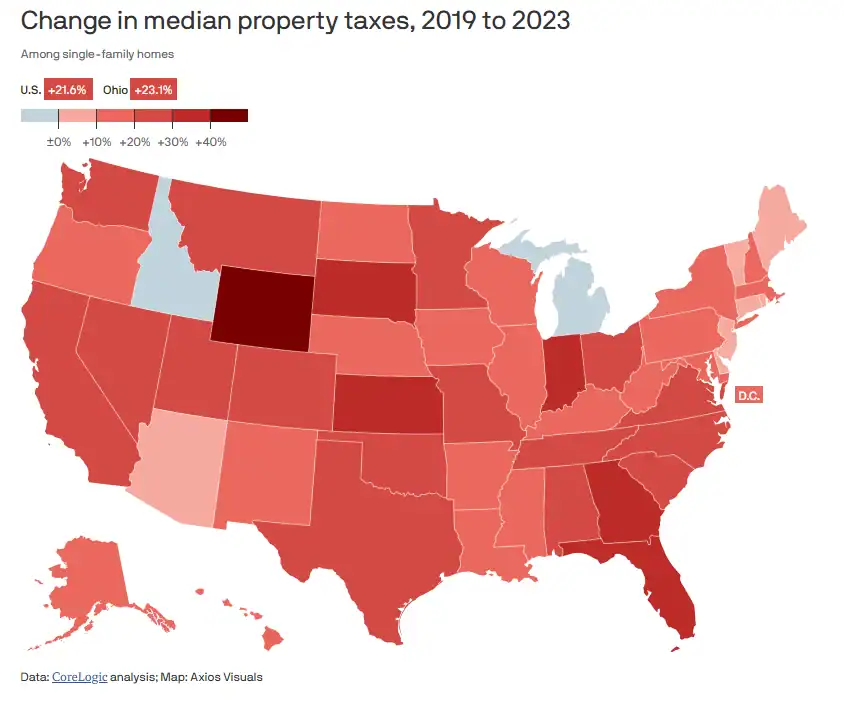
The issue has gained attention in Northeast Ohio, where periodic property reappraisals have led to higher valuations and larger tax bills for many homeowners.
Advocates for eliminating property taxes say residents, particularly retirees and people on fixed incomes, are struggling to keep pace with rising housing costs.
The Statehouse News Bureau reported that opponents warn eliminating property taxes could have significant consequences for local governments and public services. Schools, police and fire departments, libraries and other local agencies rely heavily on property tax revenue.
Critics say eliminating the tax would require lawmakers to identify alternative funding sources or make substantial budget cuts.
State lawmakers continue to pursue other forms of property tax relief. State Rep. Mark Hiner, a Knox County Republican, introduced House Joint Resolution 7, which would exempt owner-occupied homes from property taxation if approved by the General Assembly and voters.
In addition to longer-term proposals, Ohio lawmakers recently approved a $350 million property tax relief fund for senior homeowners through House Bill 479.
The one-time program is expected to provide credits to eligible older homeowners facing higher tax bills as property values rise. Supporters describe the measure as immediate assistance for older Ohioans on fixed incomes, while critics say it does not address broader concerns about the state’s property tax system.
The proposals are among several measures under consideration at the Statehouse as legislators respond to homeowners’ concerns.
Activists are continuing their signature campaign, and lawmakers are debating alternative reforms, leaving the future of Ohio’s property tax system unsettled.
Brooke Adams is a freelance journalist.