Urges unity, expanded ballot access access
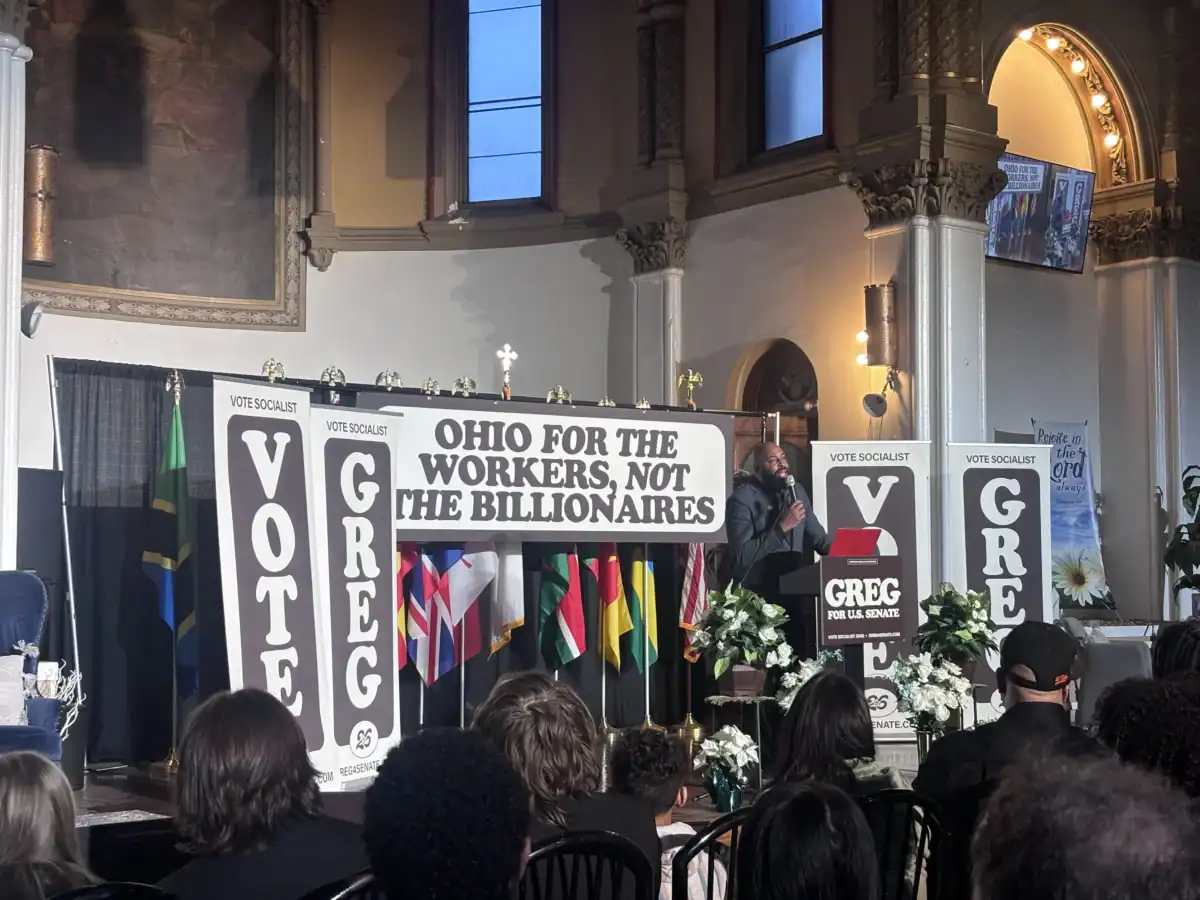
On Greg Levy, a member of the Party for Socialism and Liberation (PSL), launched his U.S. Senate campaign on Feb. 21 at Holy Trinity Church in Cleveland’s Fairfax neighborhood.
Campaign launch in Fairfax
In leaflets distributed by PSL organizers, Levy described the situation as dire for Ohioans, stating, “Ohio has been hit hard. Billionaires have gutted our cities of jobs, destroying our ability to build a dignified life in the towns we love.”
In particular, Levy wrote his policies “would serve the needs of people and the planet.” To do this, he would propose constitutional rights to a guaranteed income, housing, and healthcare, as published in detail on Levy’s program website.
Speakers reference historical struggles
Though the event focused on the future, many speakers sought to decry past injustices, which they said reflect the experiences of Black, immigrant, and working-class communities.
Pastor E. Regis Bunch, who previously served as transitional pastor at Fifth Christian Church (Disciples of Christ) in Cleveland’s Corlett neighborhood, said, “We are not gathered today just as a community, but as a community of conscience.”
Bunch recounted the experiences of his enslaved ancestors, seeking to connect their stories to the racial and economic injustices that Levy says persist today.
While researching federal archives, Bunch found the account of a woman identified as Mrs. Bakemore, who petitioned the Freedmen’s Bureau.
The bureau was established in 1865 to assist newly freed people. Bakemore filed the petition to help free her young son from an abusive apprenticeship program run by the family’s former enslavers.
When Pastor Bunch read the short note attached to the document, “No response needed,” he asked the congregation how much the system had really changed between then and now for Cleveland residents and all Black and working-class Ohioans.
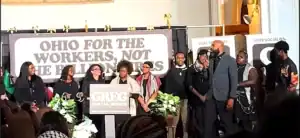
De la Cruz urges push for justice
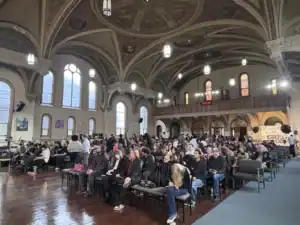
Following his speech, Claudia De la Cruz, the PSL’s 2024 presidential candidate, drew loud applause from more than 500 attendees, one campaign staffer, Charlie Koneigsmark, confirmed.
Cruz, who agreed with Bunch that the economic and racial issues of today are the same as those faced by marginalized people of the past, cited two local pieces of history that demonstrated to Cruz the struggle of Ohioans and Americans broadly to seek justice.
First, she referenced the history of Peter H. Clark, a 19th-century Black Ohioan widely recognized as the first Black American to espouse socialism, who, like Levy, combined his love for his community and local youth activism with a socialist platform to run for an Ohio congressional seat.
Next, she celebrated Malcolm X and his “The Ballot or the Bullet” speech on the anniversary of his death on Feb. 21, 1965. Cruz reminded the audience that Malcolm X’s speech was given at the Cory Methodist Church in the Glenville neighborhood in Cleveland.
Cruz said in her opinion the speech was a “Call to the oppressed. He said we had a common enemy and common fight and that if we cannot get justice through the ballot, we’d be forced to take it by any means necessary.”
She qualified this statement with the retort, “Don’t get too excited yet,” drawing laughter from the crowd.
Cruz also said the recent general strike in response to U.S. Immigration and Customs Enforcement (ICE) raids, along with protests in Ohio, are equally valuable responses to the limits of achieving economic or racial justice through voting for Democrats or Republicans.
Greg Levy urges unity, ballot access
Following speeches, ballads and poetry readings by the Robeson Singers, Greg Levy took the lectern with a rousing standing ovation. He noted that although he lives in Akron, his parents were deeply involved in Cleveland’s church communities, making the city a part of who he is. Levy sang Psalm 113 and invited the audience to participate, urging them to join together in unity.
This unity, he claimed, was the unity of Black, Brown, and Working-class Americans, since in this country, Levy stressed, “Nothing moves without us.”
Whether in the modern day or the past, he said, Ohioans have always fought for justice in their communities and for the freedom to live their best lives. Station Hope, the Underground Railroad codename for Cleveland, represented this approach, and Levy proclaimed, “Ohio and Cleveland were once Station Hope. Let them be Station Hope again!”
He followed this with a bout of call and response to the hundreds of supporters to close out his speech with a question, “How long are we going to wait for our society to use our labor to produce justice, how long?” followed by the cry of the audience, “Not Long!”
As the night wrapped up, organizers directed attendees to voter registration tables and donation QR codes for the campaign, and a petition to add Levy to the ballot on Nov. 3. Levy and Cruz both set up candidate meet-and-greets with individual supporters. Levy said he was excited about the campaign and thanked supporters for attending.
Michael Walsh is a freelance journalist based in Pittsburgh who covers community affairs.