Cleveland Observer Staff
Editor’s note: Information in this story reflects public health guidance and case information available as of July 23.
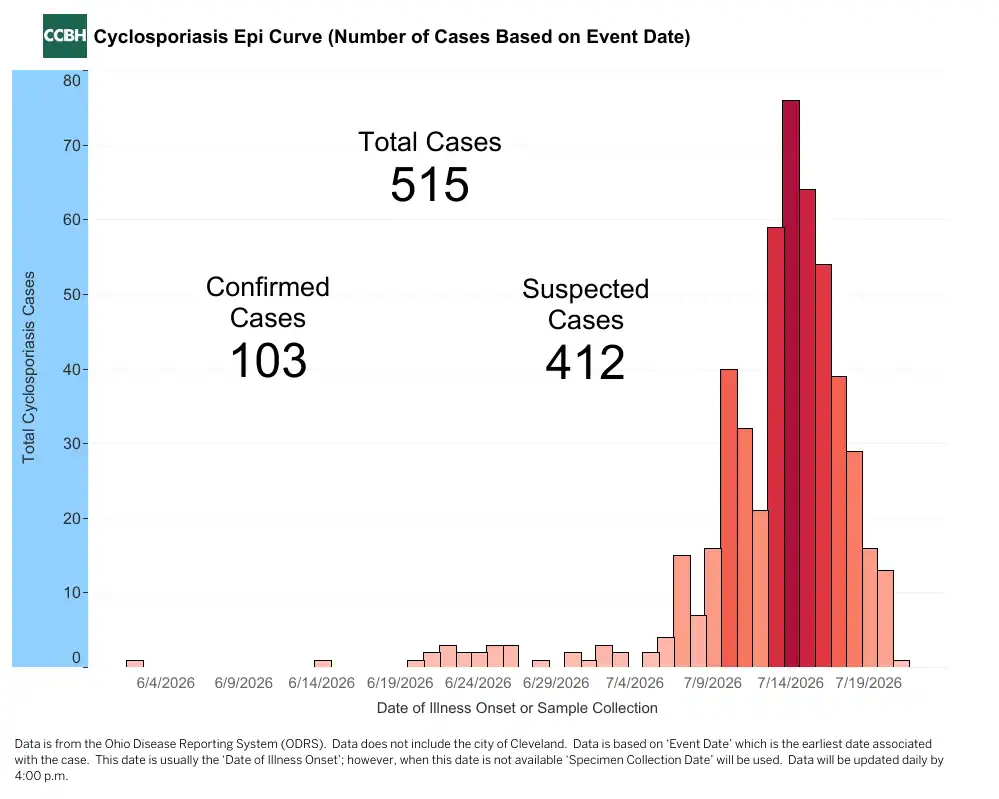
Cuyahoga County health officials are investigating a sharp increase in Cyclospora infections connected to a multistate outbreak linked to recalled iceberg lettuce, according to the U.S. Food and Drug Administration FDA.
The Cuyahoga County Board of Health said the increase in infections is affecting Ohio and Cuyahoga County as federal investigators trace illnesses to iceberg lettuce grown in central Mexico. The supplier, Taylor Farms de Mexico, voluntarily recalled the affected lettuce, according to the FDA.
Local case figures, including suspected and confirmed illnesses, remain preliminary, according to the health department. Cases may be reclassified as laboratory results, patient interviews and other investigative work are completed.
Recalled lettuce distributed in Ohio
Taylor Farms de Mexico recalled iceberg lettuce sourced from central Mexico because it may be contaminated with Cyclospora, a microscopic parasite that can cause prolonged intestinal illness.
The recalled lettuce was distributed from June 29 through July 16 to 27 states, including Ohio. It was sold through restaurants, food-service operations and retail stores under several brands and product codes. Products included bagged iceberg salad and shredded lettuce.
The recall followed federal traceback work that linked illnesses in Indiana, Kentucky, Michigan, Ohio and West Virginia to shredded iceberg lettuce served at certain Taco Bell restaurants. The FDA identified a single supplier used by locations where people who became ill reported eating.
Although the FDA later determined that an initial laboratory test on a lettuce sample was a false positive, the agency continues to advise consumers not to eat the recalled products based on its traceback and epidemiological investigation.
The FDA investigation remains ongoing, and officials have cautioned that not every Cyclospora illness reported nationally is necessarily connected to the recalled lettuce.
Cuyahoga County cases part of larger surge
The Cuyahoga County increase in reported infections was part of a national rise in cyclosporiasis that began in the spring.
Since May 1, the Centers for Disease Control and Prevention CPC has received reports of 4,173 laboratory-confirmed domestically acquired cases and more than 7,400 reports requiring further investigation. Many of the additional reports came from Michigan and Ohio.
The Associated Press reported that infections have been reported in more than 30 states and that 2026 case totals have surpassed the previous national record of about 4,700 illnesses set in 2019. Federal officials believe at least some cases in Michigan, Ohio, Kentucky and West Virginia are connected.
The AP also reported more than 1,100 illnesses in northwest Ohio and more than 3,300 in Michigan. Health officials have said the actual number of infections could be higher because people with mild symptoms may not seek medical care or be tested.
Illness can cause severe dehydration
Cyclospora infects the intestines and commonly causes frequent, watery diarrhea. Other symptoms can include stomach cramps, nausea, fatigue, loss of appetite, increased gas and weight loss.
Symptoms usually begin about a week after exposure but can appear from two days to two weeks later. They can appear to improve and then return if the infection is not treated.
Ohio Department of Health Director Dr. Bruce Vanderhoff said the illness should not be dismissed simply because most cases are treatable.
“This is a serious illness that can cause dehydration and require people to seek emergency medical care, and it should be taken seriously,” Vanderhoff said.
The illness is generally treated with antibiotics. People with persistent or recurring diarrhea should contact a healthcare provider and specifically ask about testing for Cyclospora because routine testing may not always detect the parasite.
Health department conducting interviews
The Cuyahoga County Board of Health said its response includes interviewing suspected and confirmed patients, coordinating diagnostic testing and conducting environmental health follow-up at locations connected to reported exposures.
The department urged residents to answer calls from local or state health investigators.
“Your answers help identify contaminated food faster,” the health department said in its public guidance.
Officials also noted that local, state and federal case counts may differ. Local agencies may include probable and suspected cases, while CDC and FDA outbreak numbers generally include only confirmed cases tied to particular investigations.
What residents should do
Residents should check their refrigerators for recalled iceberg lettuce, shredded lettuce and salad products from Taylor Farms de Mexico. Consumers should use the FDA recall list to check product names, sizes and dates.
Recalled products should be thrown away or returned to the store. Containers, refrigerator shelves and other surfaces touched by the lettuce should be cleaned and sanitized.
People who develop diarrhea that persists or returns should contact a healthcare provider, especially if they ate iceberg lettuce within the two weeks before becoming ill.
As of July the Cuyahoga County Board of Health Disease Team can be reached at 216-201-2080 or disease@ccbh.net.