

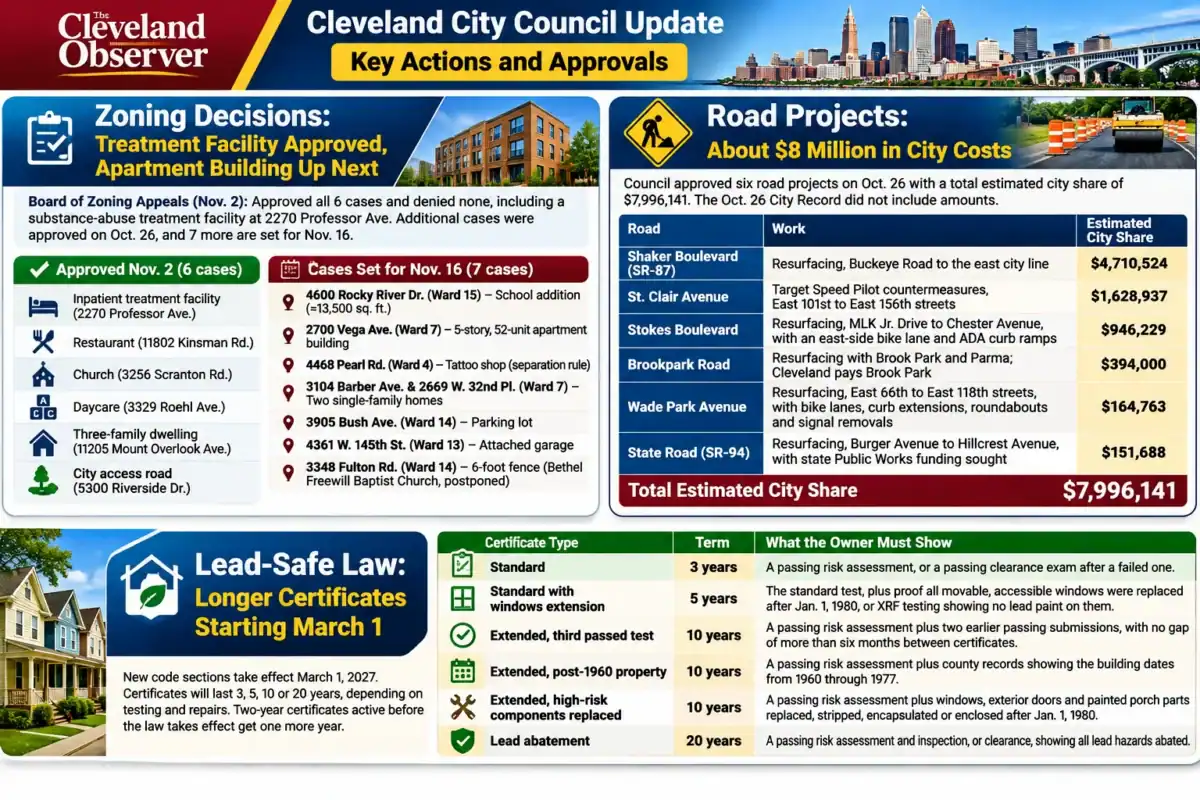
The Nov. 6 City Record prints the full lead-safe law and puts prices on six road projects totaling about $8 million. The Board of Control added $850,000 to a city engineering contract, and zoning appeals approved an inpatient addiction-treatment facility.
By The Cleveland Observer
CLEVELAND — Landlords will be able to earn lead-safe certificates lasting up to 20 years under Cleveland’s rewritten lead-safe law, whose full text appears in the Nov. 6 City Record.
Council passed the rewrite Oct. 26, but that week’s City Record printed only its title and amendments. The Nov. 6 edition, which has no council session, prints the full text of all 19 measures passed that night, including the city’s estimated costs for six road projects. It also reports new Board of Control contracts and zoning decisions.
Lead-safe law: longer certificates starting March 1
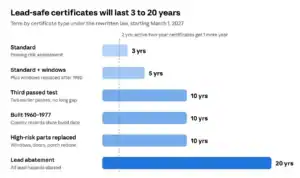
The law’s new code sections take effect March 1, 2027. Certificates will last three, five, 10 or 20 years, depending on testing and repairs. Two-year certificates active when the law passed and when it takes effect get one more year.
Before renting a unit, an owner must hold a Certificate Approving Rental Occupancy. It requires lead-safe compliance, resolved past violations, no delinquent property taxes unless on a county payment plan, and no unpaid city fines or assessments. Buildings with four or more units also need HVAC inspections every two years and current utility accounts.
Registration costs $70 per unit, due each year by March 1, with a $100 late fee. Revoking a registration or occupancy certificate brings a $100 fine. Fees are capped at $30,000 a year per apartment complex, and fines at $30,000 a year per owner.
Unless the owner is a person living in Cuyahoga or a neighboring county, the owner must name a local agent who lives in Cuyahoga County. Lead inspectors will need a city license on top of their state license and may not test properties where they have a financial or employment tie to the owner. Owners may not retaliate against tenants who report missing certification or lead hazards.
Why it matters: The ordinance cites 2025 testing in which 11.7% of Cleveland children tested had blood lead levels at or above Ohio’s 3.5 µg/dL action level. Longer terms mean fewer retests for owners who make lasting repairs, while the occupancy certificate ties a unit’s lead status, taxes and code violations to whether it can be rented.
Road projects carry about $8 million in city costs
The full ordinances put estimated city shares on the six road projects Council approved Oct. 26, totaling $7,996,141. The Oct. 26 edition printed no amounts.
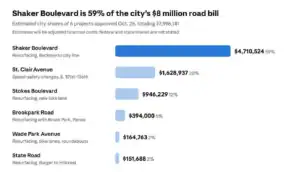
Each amount is an estimate that will be adjusted to actual costs. Most will be paid partly with 2027 Road and Bridge bonds; Brookpark Road uses 2028 bonds and takes effect Nov. 25, 30 days after passage.
Why it matters: These are only the city’s shares. The ordinances do not state total project costs or how much federal and state money is involved.
Engineering contract grows by $850,000
The Board of Control on Nov. 4 raised the ceiling on the city’s engineering contract with Soil and Materials Engineers Inc. to $3.35 million. The change lifts a modification approved Aug. 19 from $1.6 million to $2.45 million. The Observer’s Aug. 21 update reported that August action, which had brought the contract to $2.5 million.
The resolution cites grant deadlines for the 2025 Chester Avenue signal upgrades and the MLK rehabilitation project. It approves 17 sub-consultants, the largest Chagrin Valley Engineering at $1,091,486.
Why it matters: The contract started at $600,000 and has grown more than fivefold through changes approved in December 2025, August 2026 and now November.
The board also approved:
- A $1,160,500 two-year contract with P & P Valley View Holdings, doing business as Boyas Excavating, for catch debris disposal for the Division of Water Pollution Control.
- A $104,570 two-year contract with Utility Service Co. for water tank and tower inspection, cleaning and maintenance.
- Valet concessions for Great Lakes Valet at the Willard Park Garage: $20 a vehicle for a Nov. 7 gala and $12 for a Nov. 10 Tri-C luncheon.
Each was adopted 10–0, with Mayor Bibb and four directors absent.
Other new details from the Oct. 26 legislation
- The Browns stadium reimbursement, Ord. 931-2026, does not appear among the measures listed as passed Oct. 26, consistent with the 6–7 vote that defeated it.
- Sutphen Corporation’s no-bid repair and maintenance of a fire truck under warranty will cost $301,379.49.
- Public Works plans to install new traffic signal poles with city crews instead of a contractor, so Council replaced last year’s construction-contract authority with a purchase contract.
- The Warren Road bridge deck replacement over I-90 puts no financial obligation on the city, except for any features the city requests that are ruled ineligible.
Zoning: treatment facility approved, apartment building up next
The Board of Zoning Appeals approved all six cases it decided Nov. 2 and denied none. They include an inpatient, dormitory-style substance-abuse treatment facility with on-site wraparound services that Stella Maris plans in an existing three-story building at 2270 Professor Ave., in a two-family district.
The board also approved a restaurant at 11802 Kinsman Road, a church at 3256 Scranton Road, a daycare at 3329 Roehl Ave., a three-family dwelling at 11205 Mount Overlook Ave., and a city access road in the riparian and wetland setback at 5300 Riverside Drive. It adopted approvals for seven more cases heard Oct. 26.
Cases set for Nov. 16:
- 4600 Rocky River Drive, Ward 15: Cleveland Muslim Community Center seeks a roughly 13,500-square-foot school addition in a two-family district next to a one-family district.
- 2700 Vega Ave., Ward 7: a five-story, 52-unit apartment building with a 1-foot-8-inch rear yard where at least 20 feet is required.
- 4468 Pearl Road, Ward 4: a tattoo shop in a local retail district, needing relief from 1,000-foot separation rules.
- 3104 Barber Ave. and 2669 West 32nd Place, Ward 7: two single-family homes on 3,993-square-foot lots, below the 4,800-square-foot minimum.
- 3905 Bush Ave., Ward 14: a parking lot in a two-family district.
- 4361 West 145th St., Ward 13: an attached garage with a 4-foot-8-inch side yard.
- 3348 Fulton Road, Ward 14: a 6-foot chain-link fence in front and side-street yards at Bethel Freewill Baptist Church, postponed from Oct. 5.
How to weigh in
The Board of Zoning Appeals meets Monday, Nov. 16, at 9:30 a.m. in Room 514 of City Hall and on WebEx; bring ID to enter. To testify online, request the link by noon Nov. 11 at 216-664-2580 or boardofzoningappeals@clevelandohio.gov.
City Council’s office is in Room 220 of City Hall, 601 Lakeside Ave., 216-664-2840.
Rules under the lead-safe law must run in the City Record two weeks in a row and take effect 30 days after the second printing, but no earlier than March 1, 2027.
Questions that need to be answered
Lead-safe law
- How many rental units hold lead-safe certificates now, and how many two-year certificates will get the one-year extension?
- Which conditions for a Certificate Approving Rental Occupancy are new, and how will the city check taxes, utility accounts and unpaid fines before approving one?
- What criminal penalties apply under Section 240.99, which this edition does not print?
Engineering contract
- Which projects drove the $850,000 increase, and how much of the $3.35 million will grants cover?
Road projects
- What are the total costs of the six projects, and how much comes from federal and state funds?
The Cleveland Observer invites the Department of Public Health, the Department of Building and Housing, landlords, tenants and the Lead Safe Cleveland Coalition to respond. The Cleveland Observer based this report on the Nov. 6, 2026, edition of The City Record, the official weekly publication of Cleveland City Council.