

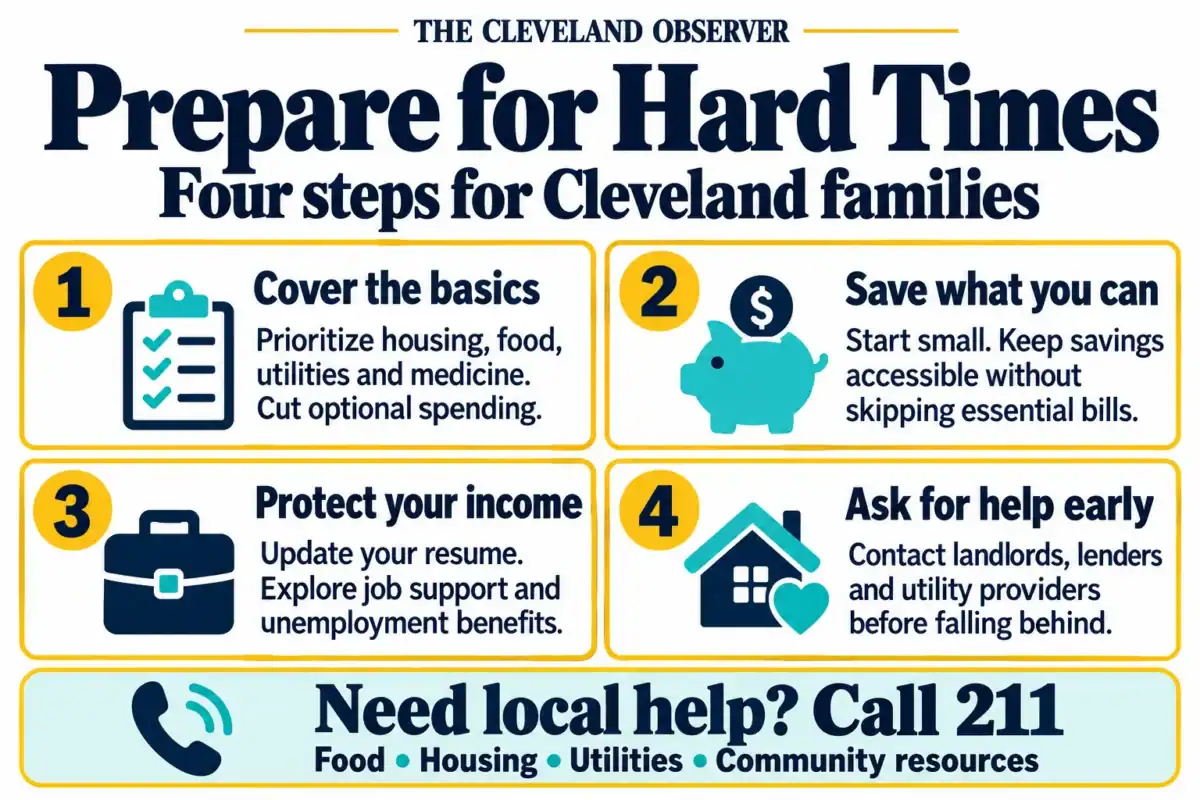
With 41% of Cuyahoga County households struggling to afford basic necessities, preparing for a recession, job loss or financial emergency can begin with practical steps — even when money is tight.
The Cleveland Observer
CLEVELAND — What would happen if your family suddenly lost a paycheck, faced rising grocery costs or received an unexpected medical bill?
For many Cleveland-area households, limited income and rising living costs make unexpected expenses difficult to manage.
According to United Way of Greater Cleveland’s 2026 State of ALICE report, 41% of Cuyahoga County households, approximately 227,000, had incomes below the level needed to consistently afford basic necessities. The June 2026 report uses 2024 household data. The percentage declined from 43% in the previous report.
ALICE stands for Asset Limited, Income Constrained, Employed. It describes households earning above the federal poverty level but below the cost of basic necessities. The 41% figure includes both ALICE households and those living in poverty.
“Families are working hard, but too many are walking a financial tightrope,” Sharon Sobol Jordan, president and CEO of United Way of Greater Cleveland, said in the organization’s June statement.
A Federal Reserve Bank of Cleveland survey, conducted March 2-13, 2026, found that 72% of responding service organizations reported declining financial well-being among the low- and moderate-income populations they served. The survey included 108 organizations across the bank’s four-state district.
Although no one can predict precisely when another recession will occur, families can take practical steps to reduce financial vulnerability.
Start with a household survival budget
Financial preparation begins with attitude. “Attitude on your outlook determines your outcome”, said James Sander, founder of New Beginnings Financial Services. “Next, identify essential expenses: housing, utilities, groceries, transportation, medications, insurance and minimum debt payments.”
Families should separate necessities from expenses they could reduce or temporarily eliminate. For example, a household spending $3,000 monthly on essentials would need $9,000 to cover three months without income or assistance.
That amount may be unrealistic for many families, but understanding monthly expenses helps identify financial risks.
Build savings, even if the amount is small
The Consumer Financial Protection Bureau recommends establishing emergency savings for unexpected expenses or income interruptions.
In guidance for prospective homebuyers, the Consumer Financial Protection Bureau says a good rule of thumb is to reserve at least three to six months’ worth of expenses for emergencies.
For families living paycheck to paycheck, however, the first goal might be saving $100, then $500 and eventually $1,000.
“Even modest savings can help avoid tradeoffs that affect health, career and family,” Cary Sinnett, senior manager of personal financial planning at the American Institute of Certified Public Accountants, said in an April 2026 statement.
Emergency funds should remain accessible, preferably in federally insured savings accounts rather than investments that could lose value. Saving should not take priority over immediate necessities such as rent, food or medication.
Reduce debt and protect income
High-interest credit cards and variable-rate loans can become especially burdensome during financial instability.
Families should review outstanding debt, avoid unnecessary borrowing and balance repayment with maintaining emergency savings.
Workers can also prepare by updating resumes, developing job skills and exploring employment opportunities. OhioMeansJobs Cuyahoga County offers free employment assistance, including job-search support and training resources. Workers experiencing job loss or reduced hours should promptly investigate eligibility for Ohio unemployment benefits.
Prepare for essential household needs
Gradually purchasing additional shelf-stable food, hygiene products and household necessities can reduce pressure during an emergency.
Families might build a one- or two-week reserve, depending on available income and storage space. Additional purchases should not interfere with current bills or medication.
Residents experiencing food insecurity can seek assistance through the Greater Cleveland Food Bank, which maintains a directory of food pantries and community meal programs.
Protect housing, utilities and health care
Families anticipating difficulty paying rent or mortgages should contact landlords, mortgage servicers or housing counselors before falling significantly behind.
Eligible Cleveland renters facing eviction may qualify for free legal representation through the city’s Right to Counsel program generally covers renters facing eviction who have at least one child in the household and income at or below the federal poverty guidelines. Other tenants may qualify for legal assistance outside the program.
Income-eligible residents may also qualify for energy assistance. The Home Energy Assistance Program (HEAP) provides a one-time annual benefit toward eligible heating costs, while the Percentage of Income Payment Plan (PIPP) establishes income-based monthly payments for eligible customers of regulated gas or electric utilities.
Losing employment can also mean losing health insurance. According to HealthCare.gov, workers generally have 60 days after losing job-based coverage to enroll in a Health Insurance Marketplace plan.
Other options may include Medicaid or temporary continuation of employer-sponsored insurance through COBRA. Eligible workers generally must pay the full COBRA premium and an administrative fee.
Financial planning has limits
Individual budgeting cannot eliminate the larger economic pressures affecting Cleveland households.
The Cleveland Fed’s June 2026 report, “When every dollar counts: Inside the economic struggles of workers who earn low to moderate incomes,” describes workers adjusting spending, relying on credit and seeking assistance to meet basic needs.
Taken together, the Cleveland Fed findings and United Way’s ALICE data suggest that conventional savings advice becomes difficult to follow when household income falls short of essential expenses.
“Effort isn’t the issue. Access to opportunity is,” Jordan said in United Way’s June statement.
Financial preparedness matters, but earnings sufficient to cover basic necessities, affordable housing, stable employment and accessible health care are also important for household resilience.
What families can do now
During the next 30 days, households can review essential expenses, identify unnecessary costs, establish realistic savings goals and organize financial documents.
Family members should also discuss how they would manage reduced income, including transportation, child care and housing responsibilities.
No household can control when the economy weakens. Having a plan before trouble arrives, however, can provide more options when difficult circumstances arise.
Where Cleveland families can find help
- United Way 211: Dial 211 or visit 211oh.org for assistance referrals.
- Greater Cleveland Food Bank: 216-738-2067. Food and benefits assistance.
- Cuyahoga Job and Family Services: 844-640-6446. Supplemental Nutrition Assistance Program, commonly known as SNAP, Medicaid and other benefits.
- Step Forward: 216-480-4327. Energy assistance.
- The Legal Aid Society of Cleveland: 888-817-3777. Free eviction help.
- OhioMeansJobs Cuyahoga County: 216-777-8200. Employment services.
- Urban League of Greater Cleveland: 216-622-0999 Financial coaching and employment resources.
Eligibility and available assistance vary by program.